
UAE Corporate Tax on Real Estate - What Every Property Business Needs to Know
⚠ Important Notice
UAE Federal Corporate Tax came into force for financial years beginning on or after 1 June 2023. If your real estate business has not yet registered, assessed its taxable income, or filed a return — you are likely already non-compliant. DgTx can help you fix that.
Let us be honest with you. When the UAE introduced its federal corporate tax regime, a lot of property businesses — landlords, real estate companies, developers, and investors — assumed it did not apply to them. Some still believe that.
They are wrong. And that misunderstanding is expensive.
The UAE corporate tax on real estate is real, it applies broadly, and the Federal Tax Authority (FTA) is watching. Whether you own a single commercial building in Business Bay, manage a portfolio of leased properties across Dubai, or run a real estate development company registered in a free zone — this tax has changed your obligations.
At DgTx, we work every day with property businesses across the UAE who are navigating exactly this confusion. This guide is our attempt to give you a clear, honest picture of how UAE corporate tax applies to real estate — and what you need to do about it.
9%
On taxable income above AED 375,000
Small business relief available
June 2023
Financial years starting on/after
Elect annually with FTA
First, Let’s Talk About Why This Matters to Your Business
You may have heard people say that individual investors who simply own property are exempt. That is partially true — but the line between an individual investor and a business conducting a real estate activity is far less clear than most people assume.
The UAE federal corporate tax law draws a distinction based on how income is earned, how it is structured, and what activity generates it. The moment real estate becomes a business activity — not just a passive personal investment — corporate tax enters the picture.
“The question is not whether you own property in the UAE. The question is whether the way you earn from that property constitutes a taxable business activity.”
This applies directly to you if you are running a real estate company in Dubai, a property management firm, a development company, a commercial leasing business, or if you hold properties through a corporate structure. Each of these situations brings you within the scope of UAE corporate tax for real estate businesses.
What Does “Business Activity” Actually Mean in a Real Estate Context?
The FTA has been reasonably specific here. Real estate business activity in the UAE includes, but is not limited to, the following situations where corporate tax is likely to apply. Property developers building units for sale, companies that lease commercial or residential properties to third parties, businesses providing property management services, real estate brokerages and consultancies, and entities holding and managing real estate portfolios through corporate vehicles are all within scope.
What is not within scope, generally speaking, is a natural person — meaning an individual human being, not a company — earning rental income from properties they own in their personal name, provided that income does not constitute a business activity. This is an important nuance. The threshold has not been fully codified in every scenario, which is why getting professional advice is genuinely important here, not just something consultants say to generate business.
Who Is Affected by UAE Corporate Tax in Real Estate?
Real Estate Companies (LLC, PJSC)
Any UAE-registered company with real estate as its primary or secondary business activity. Fully in scope.
Property Developers
Companies developing land or buildings for sale or lease. All profits from development activity are taxable.
Property Management Firms
Businesses managing properties on behalf of third-party owners. Service income is taxable business income.
Commercial Landlords
Companies that own and lease commercial property — offices, retail, warehouses. Rental income is taxable.
Individual Investors (Personal Name)
Natural persons earning rental income in their own name — generally exempt unless activity constitutes a business.
Free Zone Real Estate Companies
Potentially eligible for 0% rate if they meet Qualifying Free Zone Person criteria — conditions apply strictly.
Understanding Taxable Income for Real Estate Businesses in the UAE
This is the part where things get practical. Once we establish that your business is within scope, the next question is: what exactly is taxable, and what can you deduct?
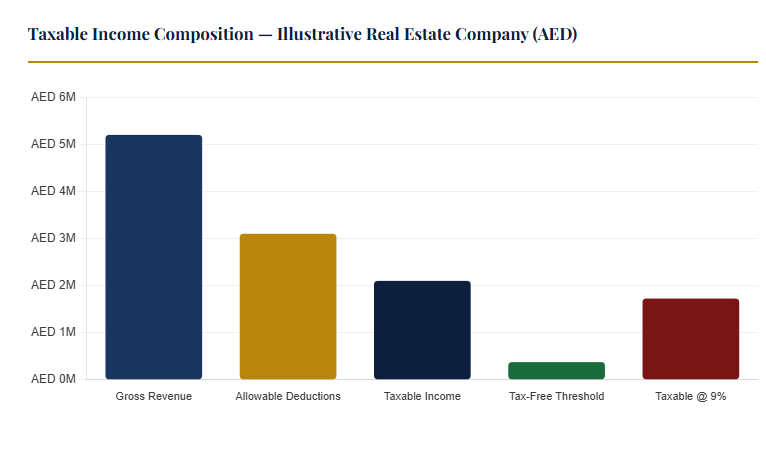
Taxable income for a real estate business in the UAE is, broadly, your accounting net profit — the number that appears at the bottom of your income statement under IFRS or another acceptable accounting standard — adjusted for specific add-backs and deductions permitted under the UAE Corporate Tax Law.
What Counts as Taxable Income in a Real Estate Business?
The following types of income generated by real estate businesses are generally included in the taxable income calculation. Commercial rental income from offices, warehouses, retail units, and industrial properties falls squarely within scope. Revenue from property development and sales — the profit margin on units sold — is taxable. Fees from property management, leasing advisory, and brokerage services count as taxable business income. Income from short-term holiday rentals operated through a corporate entity is also taxable. Income from providing facilities management or maintenance services linked to real estate operations is taxable business income.
Key Allowable Deductions
Here is where real estate businesses can significantly reduce their taxable profits — if they know what they are doing and keep the right records. The UAE corporate tax regime does allow deductions for expenses that are wholly and exclusively incurred in generating taxable income.
Deductible Item | Conditions | Common Pitfall |
|---|---|---|
Depreciation on owned properties (investment properties under cost model) | Must use consistent accounting policy; fair value gains/losses have separate treatment | Mixing fair value and cost models incorrectly across portfolio |
Finance costs / interest on property loans | Subject to 30% EBITDA cap on net interest deductions (General Interest Limitation Rule) | Not accounting for the interest cap — deducting more than allowed |
Maintenance and repairs | Revenue nature only; capital improvements are not immediately deductible | Capitalising vs expensing the wrong items |
Staff salaries and benefits | Market rate; related-party salaries subject to arm’s length test | Owner-director paying themselves above-market salaries |
Professional fees (legal, audit, advisory) | Must relate to taxable business operations | Deducting personal advisory fees through the company |
Agent commissions and sales costs | Must be arm’s length if paid to related parties | Related-party commissions without transfer pricing documentation |
⛔ Non-Deductible Items to Watch
Fines and penalties paid to the FTA or other government bodies are not deductible. Distributions to shareholders — dividends — are not deductible. Personal expenses of owners or shareholders claimed through the company are not deductible. Interest payments on loans used to acquire exempt income are not deductible. Bribes and illegal payments are explicitly excluded.
The Corporate Tax Rates — And What They Mean for Property Businesses
The structure of UAE corporate tax rates is not complicated, but understanding how it applies at different income levels matters enormously for planning purposes — especially for businesses with thin margins or significant debt costs.
Note on Effective Rates
The effective rate (total tax ÷ total income) is always lower than 9% because the first AED 375,000 is taxed at 0%. A business earning AED 2,000,000 taxable income pays tax of AED 146,250 — an effective rate of approximately 7.3%, not 9%.
What About the Multinational Top-Up Tax?
If your real estate group is part of a multinational enterprise group with global revenues exceeding EUR 750 million (approximately AED 3 billion), a separate Qualifying Domestic Minimum Top-up Tax (QDMTT) may apply to bring your effective tax rate up to 15% — consistent with the OECD Pillar Two framework. This is relevant for large international real estate groups operating in the UAE, and DgTx advises several such clients on QDMTT compliance.
note: we also offer shared CFO services too.
Corporate Tax on Rental Income in the UAE — A Closer Look
This is perhaps the most frequently asked question we receive at DgTx: is rental income subject to corporate tax in the UAE? The answer depends entirely on who is earning it and how.
Rental income earned by a UAE corporate entity — a company, LLC, or other juridical person — from commercial properties is taxable business income. Full stop. There is no general exemption for rental income at the corporate level in the way that exists for individual investors.
This matters enormously because many commercial property owners in Dubai have structured their portfolios through companies — often for liability protection, financing purposes, or historical reasons. Those companies are now taxable persons under UAE corporate tax law, and their rental income flows through to taxable profits.
Scenario | Income Type | Corporate Tax Applies? | Notes |
|---|---|---|---|
UAE LLC owns commercial offices, receives rent from tenants | Commercial rental income | YES | Standard 9% on taxable profit above threshold |
UAE LLC owns residential apartments, leases to families | Residential rental income | YES | Corporate vehicle — income is taxable regardless of property type |
Individual (natural person) receives residential rent in personal name | Personal rental income | NO* | *Unless the activity constitutes a business — factual determination required |
Free zone company receives rental income from UAE mainland tenants | Commercial rental income | COMPLEX | Mainland-sourced income may be excluded from QFZP qualifying income — seek advice |
Property developer sells completed units | Development profit (capital gain-like) | YES | Treated as ordinary business income, not exempt capital gain |
Holding company receives dividends from a real estate subsidiary | Dividend income | EXEMPT* | *Participation exemption may apply — conditions must be met |
💡 DgTx Insight
One issue we frequently encounter is clients who own commercial properties through a UAE company and assume the income is not taxable because the property itself is not “a business.” This is a misunderstanding. The company — as a legal entity — is a taxable person. All income it earns, including rental income from commercial property in Dubai, is subject to corporate tax unless a specific exemption applies.
Free Zone Real Estate Companies — The Rules Are Strict
Free zones have been central to the UAE’s business model for decades, and many real estate companies are established in free zones like DIFC, ADGM, DMCC, or others. The corporate tax treatment for free zone real estate companies is one of the most misunderstood areas in the entire UAE tax landscape right now.
The headline: free zone companies can access a 0% corporate tax rate — but only on “Qualifying Income,” and only if they meet the requirements to be classified as a Qualifying Free Zone Person (QFZP). If they do not meet those conditions, they are taxed at the standard 9% rate.
QFZP Qualification Checklist for Free Zone Real Estate Entities
Maintains adequate substance in the UAE free zone (employees, premises, decision-making)
Derives income that qualifies as “Qualifying Income” under Cabinet Decision No. 55 of 2023
Has not elected to be subject to the standard corporate tax regime
Complies with the de minimis threshold (non-qualifying income does not exceed 5% of total revenue or AED 5,000,000 — whichever is lower)
Has audited financial statements prepared under IFRS
Has not made a taxable distribution that would disqualify it
Related-party transactions are conducted at arm’s length
The Critical Issue: “Excluded Activities” for Free Zone Companies
Here is the issue that trips up many free zone real estate companies. Certain activities are classified as “Excluded Activities” under the UAE corporate tax rules. Income from excluded activities cannot be treated as Qualifying Income — even if the entity otherwise meets all QFZP conditions.
Critically, owning or exploiting immovable property located in the UAE mainland — meaning commercial or residential property outside a designated free zone — generates income that is typically not Qualifying Income for free zone companies. This means a free zone company earning rental income from mainland Dubai commercial properties may not be able to apply the 0% rate to that income. It could face the standard 9% rate.
Free Zone Property Companies — Watch This
If your free zone entity earns rental income from UAE mainland properties, that income may be treated as non-qualifying. If it exceeds the de minimis threshold, it can disqualify the entire entity from QFZP status — meaning all of your income, including qualifying income, becomes taxable at 9%. This is a real and significant risk that DgTx identifies in client portfolios regularly.
UAE Corporate Tax Registration for Real Estate Companies — What You Need to Do
Let us talk about process. Understanding the tax rules is one thing. Actually complying —corporate tax registering with the FTA, filing returns, paying tax on time — is another. Many real estate businesses in Dubai are behind on this. If that includes you, here is what the compliance journey looks like.
Determine Your Status
Assess whether your entity is a Resident Taxable Person, Non-Resident with a UAE Permanent Establishment, or potentially a Qualifying Free Zone Person. This is not always straightforward for real estate holding structures.
Register with the FTA
All taxable persons must register via the EmaraTax platform. Registration must be completed by the deadline applicable to your financial year-end. Late registration attracts administrative penalties.
Establish Your Accounting Period
Your corporate tax period aligns with your financial year. Most UAE companies have a December 31 or March 31 year-end. Your first taxable period is the first financial year starting on or after June 1, 2023.
Prepare Compliant Financial Statements
Your taxable income starts from your accounting profit. Financial statements must be prepared using an acceptable accounting standard — typically IFRS or IFRS for SMEs. Audited accounts are required for revenue above AED 50 million.
Calculate Taxable Income with All Adjustments
Apply required adjustments: add back non-deductible items (entertainment expenses over 50%, fines, etc.), apply interest limitation rules, assess transfer pricing adjustments for related-party transactions.
File the Corporate Tax Return
The return must be filed within 9 months of your financial year-end. For a December 31 year-end, the deadline is September 30 of the following year. Filing is done electronically through EmaraTax.
Pay Corporate Tax Due
Tax is due by the same 9-month deadline as the return. Late payment results in a 14% per annum penalty on the amount unpaid. There are no formal instalment arrangements currently available in the UAE.
Penalties for Non-Compliance
The FTA has made clear that it takes compliance seriously, and the penalties for real estate businesses that fail to meet their corporate tax obligations are significant.
| Violation | Penalty |
|---|---|
Failure to register for corporate tax | AED 10,000 (one-time fixed penalty) |
Failure to file the corporate tax return on time | AED 500 per month for first 12 months; AED 1,000 per month thereafter |
Failure to pay corporate tax on time | 2% of unpaid tax immediately; then 4% every 3 months — capped at 300% |
Failure to maintain required records | AED 10,000 per violation; AED 50,000 for repeat violations |
Tax evasion | 5x the evaded tax amount; potential criminal prosecution |
Related-Party Transactions and Transfer Pricing in Real Estate Groups
This is an area where real estate groups — particularly those with multiple companies, holding structures, or family office arrangements — face significant hidden risk. The UAE corporate tax law includes robust transfer pricing rules that require transactions between related parties to be conducted at arm’s length.
In a real estate context, related-party transactions are extremely common. A parent company lending money to a subsidiary that owns a commercial building. A property management company owned by the same family group charging fees to related property-owning entities. A developer receiving land from a related holding company. A group treasury function charging interest to operating real estate companies.
All of these transactions must be priced as if they were between independent parties dealing at arm’s length. If they are not — and the FTA investigates — the authority can adjust the taxable income of the entities involved, potentially resulting in double-taxation within the group along with penalties.
📋 Transfer Pricing Documentation Requirements
UAE businesses with related-party transactions exceeding AED 40 million in total, or with any single related-party transaction exceeding AED 4 million, are required to maintain a Master File and Local File as per OECD guidelines. Real estate groups with intercompany loans, service arrangements, or asset transfers typically exceed these thresholds easily.
How UAE Corporate Tax Is Reshaping the Dubai Property Market
Beyond individual compliance, it is worth stepping back and looking at the bigger picture. The introduction of UAE corporate tax on real estate is not happening in isolation. It is part of a broader shift in how the UAE positions itself fiscally — moving from a zero-tax environment to a competitive but compliant tax framework that meets international standards.
What does this mean for the Dubai property market, commercially speaking? Let us be direct about both the challenges and the opportunities.
Corporate Tax Impact on Key Real Estate Business Metrics
Challenges for Commercial Property Businesses
The most immediate challenge for commercial real estate businesses in the UAE is margin compression. Dubai commercial property has always been a high-value, relatively high-yield market — but it is not a high-margin business after financing costs, maintenance, vacancy periods, and management fees. Adding a 9% tax on net profits puts pressure on businesses that have not previously needed to account for this cost.
For developers, the timing mismatch between recognising costs and revenues under IFRS adds complexity to taxable income calculations — particularly for long-cycle developments where revenue may be recognised over years. For property management companies, the staff-intensive nature of the business means relatively thin margins, making every deduction count.
Opportunities Emerging from Compliance
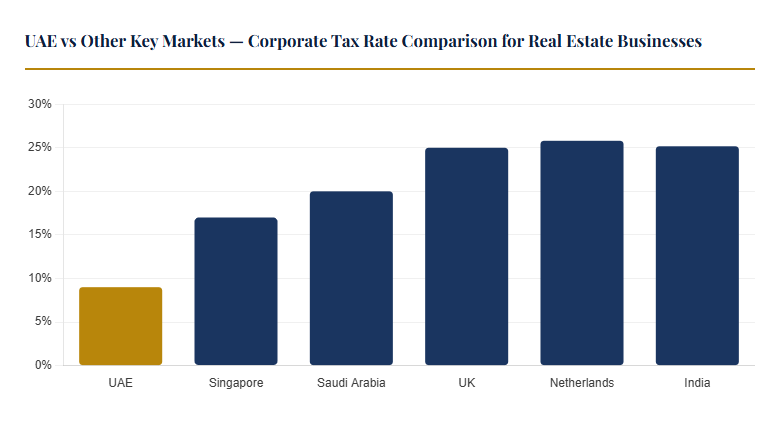
Here is the counter-intuitive truth. The introduction of corporate tax is, in many ways, accelerating professionalisation of the UAE real estate sector in ways that will benefit well-run businesses. Institutional investors — family offices, private equity, REITs — are more comfortable with jurisdictions that have transparent, predictable tax frameworks. The UAE’s move to a 9% rate places it among the most competitive corporate tax environments globally while removing the reputational risk of a zero-tax label.
For businesses that get compliance right — that maintain good records, plan their structures carefully, and work with professionals who understand the rules — the competitive advantage of operating from the UAE remains very strong.
Exemptions and Reliefs That Real Estate Businesses Should Know About
Not everything in the UAE corporate tax regime works against real estate businesses. There are specific exemptions and reliefs that, if correctly identified and applied, can significantly reduce your effective tax burden. The challenge is knowing which ones you qualify for and how to claim them properly.
| Exemption / Relief | Who Can Benefit | Key Conditions | Relevant for Real Estate? |
|---|---|---|---|
Small Business Relief | UAE-resident taxable persons with revenue ≤ AED 3 million | Annual election required; cannot be member of a multinational group | YES — small landlord companies, boutique developers |
Participation Exemption (dividends and capital gains) | Companies receiving dividends or capital gains from qualifying subsidiaries | 5%+ ownership; minimum 12-month holding; subsidiary must be subject to sufficient tax | YES — real estate holding structures, group dividend flows |
Free Zone 0% Rate | Qualifying Free Zone Persons | Strict substance, qualifying income, and de minimis requirements | CONDITIONAL — excludes most mainland property income |
Tax Loss Carry Forward | All taxable persons | Losses can be carried forward indefinitely; capped at 75% of taxable income in the offset year | YES — developers with early-stage losses can offset future profits |
Intragroup Relief | UAE-resident group companies with 75%+ common ownership | Both entities must be UAE residents; neither can be a free zone company applying 0% rate | YES — property groups can transfer losses between entities |
Government Entity Exemption | UAE federal or emirate government entities | Must be listed in a Cabinet Decision | VERY LIMITED — private real estate businesses generally excluded |
✅ Often Missed: Tax Loss Carry Forward for Developers
Real estate developers frequently incur significant costs in early phases of a project — land acquisition, design, infrastructure — before any revenue is recognised. These losses can be carried forward and offset against taxable profits in later years when units are sold. Proper accounting and documentation of these early-stage losses is essential and often overlooked without professional tax advice.
Practical Tax Planning Strategies for UAE Real Estate Businesses
At DgTx, we believe that tax planning is not about finding loopholes. It is about understanding the rules thoroughly enough to ensure you never pay more tax than the law requires — and that you structure your affairs to take full advantage of legitimate reliefs and exemptions. Here is what that looks like in practice for real estate businesses in the UAE.
1. Review Your Corporate Structure Before Your Next Period Ends
The structure through which you own and operate property has a direct bearing on your tax position. A single company holding all properties may create an unnecessarily high tax bill compared to a group structure that allows loss offsetting between entities. Conversely, an overly complex structure with too many free zone companies may inadvertently disqualify entities from reliefs they would otherwise enjoy. DgTx undertakes structure reviews for real estate groups regularly and the findings are frequently material.
2. Elect Small Business Relief if You Qualify
If your real estate company has revenue below AED 3 million, you may elect for Small Business Relief, which treats your taxable income as zero for the period. This election must be made in your tax return for each relevant period. It is not automatic. Many smaller property companies that qualify are not making this election simply because they do not know about it.
3. Align Your Accounting Policy with Your Tax Position
Investment properties can be carried under either the fair value model or the cost model under IAS 40. The tax treatment of fair value gains and losses differs from depreciation on the cost model. Depending on your portfolio and strategy, one approach may result in a more favourable tax position than the other. This is a decision that needs to be made with both your auditors and your tax advisors working together.
4. Document Your Related-Party Transactions Contemporaneously
Do not wait until the FTA comes asking. Transfer pricing documentation — Master File and Local File — should be prepared at the same time as the transactions occur, or at least by the time the tax return is filed. Retroactive documentation is harder to defend and creates audit risk.
5. Plan the Timing of Asset Disposals
If you are considering selling a commercial property, the timing of that disposal relative to your financial year-end can affect how the gain is taxed and whether any available loss offsets can be applied. This is basic tax timing planning, but it requires someone watching your position actively — not reviewing it annually after the fact.
Why UAE Real Estate Businesses Work with DgTx
We have been asked why a property business should work with DgTx rather than a general accounting firm. The answer is straightforward: UAE corporate tax for real estate is a specialist area. The intersection of real estate accounting standards, IFRS treatment of investment properties, transfer pricing rules for property groups, and free zone qualification rules is genuinely complex. Most general practitioners do not live in this intersection every day. We do.
Specialist Real Estate Tax Advisory
We focus on UAE real estate tax. Not as one of many service lines — as a core practice area where we develop genuine corporate tax expertise.
FTA Registration and Filing Support
We handle corporate tax registration, return preparation, and filing for real estate companies from start to finish.
Structure Reviews and Planning
We review your corporate and property ownership structure and identify tax planning opportunities specific to UAE real estate law.
Transfer Pricing for Property Groups
We prepare Master Files and Local Files for real estate groups with related-party transactions that require documentation.
FTA Audit Support
If you receive an enquiry or audit notification from the FTA, we represent your interests and manage the process professionally.
Free Zone Compliance
We advise free zone real estate entities on QFZP qualification, de minimis calculations, and qualifying income analysis.