Corporate Tax Filing Deadline in the UAE: Every Date, Penalty...
Read Full Blog Article
If you have ever tried to work out whether VAT services in Dubai applies to your apartment purchase, your rental income, or the villa you are building in Sharjah, you have probably landed on three different answers from three different sources. That confusion is understandable — UAE VAT law treats residential property differently depending on what stage of its life the property is in, and the rules were never designed to be read in isolation from the wider VAT Executive Regulation.
This guide sets out, in full, how VAT on residential property in UAE actually works in 2026: what is zero-rated, what is exempt, what is standard-rated, how mixed-use buildings are treated, and how UAE nationals can claim back VAT on a new home. Wherever a rule has a practical consequence for buyers, landlords, tenants, or developers, we have flagged it.

Almost every question about VAT on residential property in the UAE can be answered by three underlying rules. Everything else in this guide is really just detail layered on top of these three principles.
| Situation | VAT Treatment | Rate |
|---|---|---|
| First supply (sale or lease) of a new residential building, within 3 years of completion | Zero-rated | 0% |
| Any subsequent sale or long-term lease of a residential property | Exempt | No VAT charged, no output tax |
| Short-term or serviced residential lets (hotel-style stays) | Standard-rated | 5% |
The policy logic behind this structure is straightforward: the UAE government wants VAT to be broadly neutral for people buying homes to live in or renting them long-term, while still capturing tax on commercially operated, hotel-style accommodation that competes directly with the hospitality sector.
 A developer’s first sale or lease of a residential building is zero-rated, provided the supply happens within three years of the building’s completion. “Completion” is generally taken as the date the building is certified fit for occupation, not the date construction physically finishes.
Zero-rating is more favourable than exemption for developers because it allows them to recover the input VAT incurred on construction costs — materials, contractor fees, professional services — while charging 0% output VAT to the buyer. This is what keeps new-build residential property VAT-neutral rather than more expensive than the pre-VAT era.
 The Executive Regulation sets out that a residential building is one designed for occupation by a natural person as a main place of residence. This includes:
It excludes hotels, motels, bed-and-breakfast establishments, hospitals, and serviced apartments where hospitality-style services are provided — these are standard-rated regardless of how long the guest stays.
Once a residential property has been sold once as a new build (or if it is simply not “new” — i.e., more than three years past completion, or already occupied), all further sales and long-term leases are VAT-exempt. This is the treatment that applies to the vast majority of the UAE’s existing residential stock, including virtually every apartment being rented out on a standard one- or two-year tenancy contract in Dubai, Abu Dhabi, and Sharjah.
| Aspect | Exempt Treatment Means |
|---|---|
| Output VAT | Landlord charges no VAT on rent; tenant pays no VAT |
| Input VAT recovery | Landlord generally cannot reclaim VAT on maintenance, agency fees, or renovation costs tied to the exempt unit |
| VAT registration | Exempt residential rent does not count toward the AED 375,000 mandatory registration threshold |
| Invoicing | No tax invoice is required for an exempt residential lease |
This is an important distinction for landlords to internalise: because residential leasing is exempt rather than zero-rated, VAT paid on things like agency commission, cleaning services between tenancies, or minor refurbishment is typically a real, irrecoverable cost that should be factored into pricing.
The most common compliance mistake DgTx sees among Dubai landlords involves short-term and holiday-home rentals. If a residential unit is rented out on a short-term basis with hotel-like services — daily housekeeping, linen changes, reception, concierge — the FTA treats this as standard-rated serviced accommodation, not exempt residential leasing, regardless of the fact that the underlying property is a residential apartment.
This matters enormously for the growing number of owners listing units on short-term rental platforms. Once taxable short-term rental income crosses the AED 375,000 threshold, VAT registration becomes mandatory, and 5% VAT must be charged and remitted on that income.
The sale of genuinely bare, undeveloped land is exempt from VAT under FTA Public Clarification VATP002. However, the moment land is partially developed — even a boundary wall, levelling works, or basic utility connections — it can lose its “bare land” status and become standard-rated instead of exempt. Buyers acquiring land for residential development should have the seller confirm exactly what infrastructure, if any, has already been added.
Many towers across Dubai and Abu Dhabi combine residential floors with ground-floor retail, commercial office space, or serviced facilities. In these buildings, VAT servies in Dubai cannot simply be applied uniformly — the exempt residential component and the standard-rated commercial component must be apportioned, usually on a floor-area or usage basis.
| Building Component | VAT Treatment |
|---|---|
| Residential apartments (long-term lease) | Exempt |
| Ground-floor retail units | Standard-rated (5%) |
| Shared services charged to residential tenants only | Generally exempt, following the residential unit |
| Shared services charged to commercial tenants | Standard-rated |
| Building-wide input VAT (e.g. facade maintenance) | Apportioned pro-rata between exempt and taxable use |
Owners’ associations and landlords with mixed portfolios are a recurring FTA audit firm focus precisely because apportionment errors are common and often unintentional. Getting the apportionment method documented and consistently applied is one of the simplest ways to reduce audit risk.
A separate but closely related scheme allows UAE nationals to reclaim VAT incurred while building or rebuilding a private family residence. This scheme was significantly expanded in 2026 under FTA Decision No. 5 of 2026, effective from 1 January 2026, broadening the categories of construction e invoicing cost that qualify for refund.
| Newly Eligible Cost Categories (2026 expansion) | Condition |
|---|---|
| Home gyms and games rooms | Must be integral to the residence |
| Landscaped and agricultural areas within the plot | Must be within the residential boundary |
| Staff accommodation (watchmen, drivers, domestic staff) | Must be on the same plot, connected to the main residence |
| Smart home and integrated security systems | Built-in, not portable devices |
| Swimming pools, fountains, decorative water features | Part of the residential plot |
| Full demolition and reconstruction costs | Same private residence, personal/family use only |
To qualify, the applicant must be a UAE national and Family Book holder, the property must be for personal or family use only (not for rent, resale, or business purposes), and the claim must be filed within 12 months of the Building Completion Certificate. Claims are submitted through the EmaraTax platform, with supporting invoices scanned via the Maskan app, followed by an FTA review and site verification.
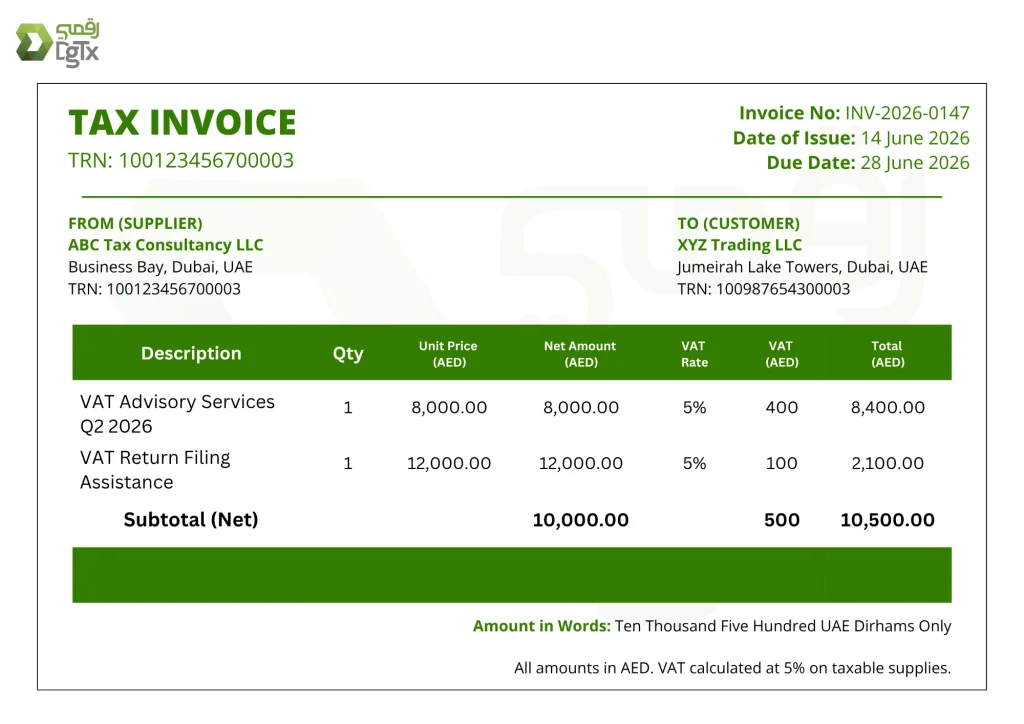
Two developments outside VAT law itself are now directly affecting how residential property VAT is documented and reported:
In most cases, no. The first sale of a new residential property within three years of completion is zero-rated, and later sales or long-term leases are exempt. Short-term, hotel-style lets are the main exception and are standard-rated at 5%.
Both mean no VAT is added to the price the buyer or tenant pays. The difference is behind the scenes: a zero-rated supplier can still recover input VAT on related costs, while an exempt supplier generally cannot.
Exempt residential rent does not count toward the AED 375,000 mandatory registration threshold on its own. A landlord with taxable activities too, such as commercial units or short-term lets, may still need to register and apportion accordingly.
Yes, through the New Residence VAT Refund Scheme via EmaraTax and the Maskan app, subject to a 12-month claim deadline from the Building Completion Certificate and the 2026 expanded list of eligible construction costs.
VAT must be apportioned between the exempt residential component and the standard-rated commercial component, typically based on floor area or another fair, consistently applied method.
This article is provided for general informational purposes and reflects UAE VAT rules as understood as of July 2026. It does not constitute tax advice. VAT treatment can depend on the specific facts of a transaction, and DgTx recommends obtaining tailored advice from a registered tax agent before making decisions based on this content.

Corporate Tax Filing Deadline in the UAE: Every Date, Penalty...
Read Full Blog Article
VAT on Bank Charges in UAE: The Complete 2026 Guide...
Read Full Blog Article
How to Submit VAT in the UAE: A Step-by-Step Guide...
Read Full Blog Article
Taxpayer Identification Number (TIN) in UAE: A Complete Guide for...
Read Full Blog Article