
Submitting VAT is not one action but two, and conflating them is the single most common cause of avoidable penalties in the UAE. The first action is filing — declaring to the Federal Tax Authority what you collected and what you paid during a defined tax period, using the return known as Form VAT 201. The second action is settlement — moving the money to the FTA if the return shows a balance payable.
Both are due on the same date, but they are separate transactions on separate rails. A business can file a perfectly accurate return on the 27th and still incur interest because the bank transfer landed on the 30th.
The return itself is a reconciliation. Output VAT is the 5% you charged your customers on taxable supplies. Input VAT is the 5% you paid your suppliers on recoverable business costs. The difference determines whether you owe the FTA or the FTA owes you.
Any business holding an active Tax Registration Number must submit a VAT return for every tax period assigned to it. Registration itself is driven by turnover.
Annual Taxable Turnover | Registration Position | Submission Obligation |
Above AED 375,000 | Mandatory registration | Must submit a VAT return every tax period |
AED 187,500 to AED 375,000 | Voluntary registration available | If registered, must submit every tax period |
Below AED 187,500 | Registration not available | No VAT return to submit |
Registered but no activity in the period | Registration remains active | Must still submit a nil return |
Table 1. Who is required to submit a VAT return in the UAE.
This trips up dormant companies and seasonal businesses every quarter. If your TRN is active, the obligation to submit exists whether or not you traded. A period with no sales and no purchases still requires a return showing zeros. Skipping it produces the same fixed penalty as skipping a period with a six-figure liability.
The FTA assigns your tax period at registration. The general rule is turnover-driven, though the Authority may assign a custom period based on business structure, activity or compliance history. Your assigned period and its due dates are visible in your EmaraTax dashboard, and that is the authoritative source for your own business.
Tax Period | Typically Assigned To | Return and Payment Deadline |
Monthly | Businesses with annual turnover of AED 150 million or more | 28th day of the month following the period end |
Quarterly | Businesses with annual turnover below AED 150 million | 28th day of the month following the quarter end |
Custom period | Assigned at the FTA’s discretion | As stated in the EmaraTax dashboard |
Table 2. UAE VAT tax periods and submission deadlines.
The 28-day rule in practice Article 64 of the VAT Executive Regulation sets the same date for the return and the payment: the 28th day following the end of the tax period. If the 28th falls on a weekend or public holiday, do not assume an extension. Treat the payment date, not the filing date, as your calendar entry, and put it at least three working days before the 28th. |
Almost every filing error is really a preparation error. Assemble the following before you open the portal, and the submission itself becomes a data-entry exercise rather than a research project.
The diagram below maps the full journey from closing the books to archiving the acknowledgement. The narrative steps follow underneath.
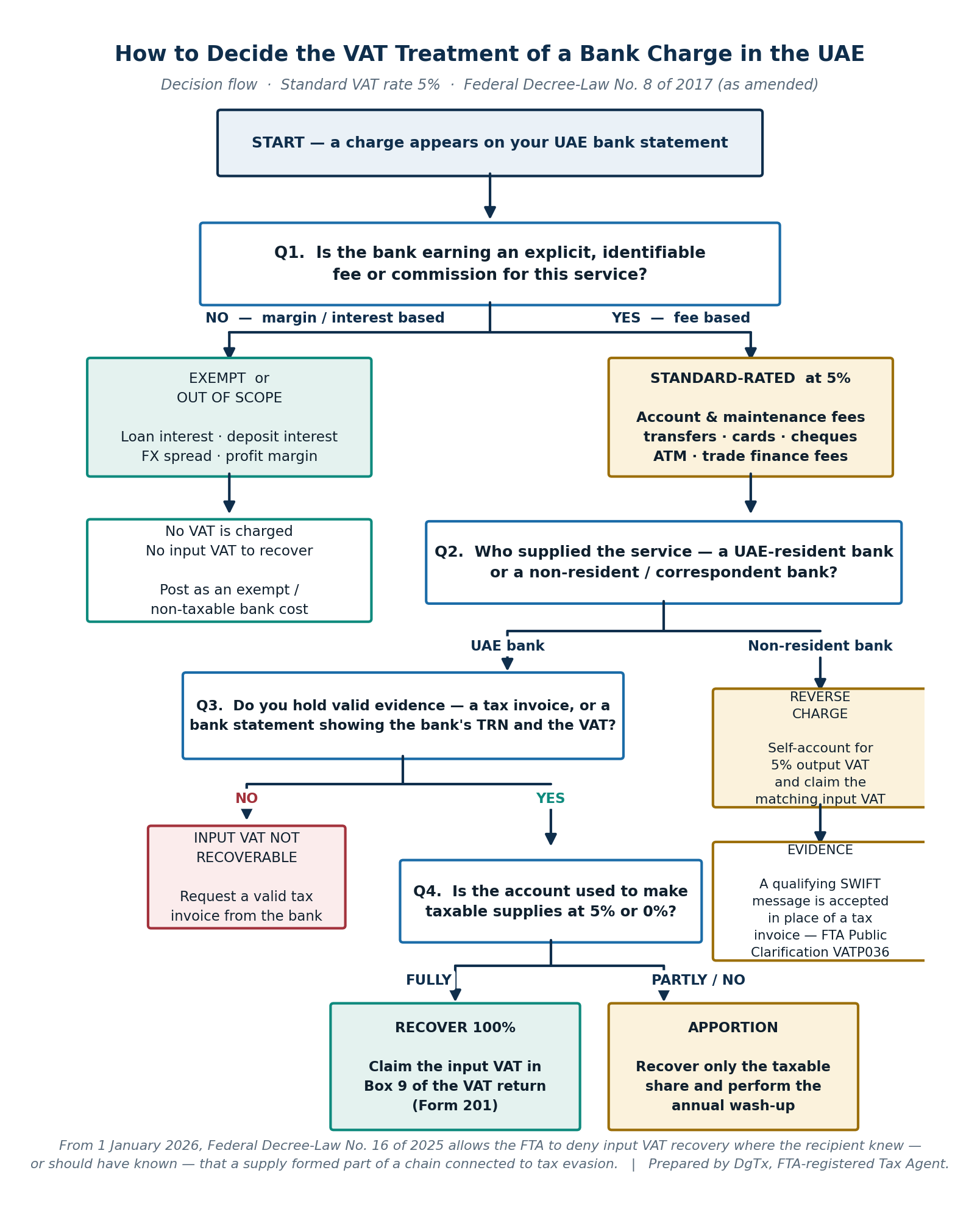
Diagram 1. The three phases of submitting VAT in the UAE — prepare, file, and pay.
Form 201 is organised into seven sections: taxpayer details, the return period, VAT on sales and other outputs, VAT on expenses and other inputs, net VAT due, additional reporting requirements, and the declaration. The numbered boxes that carry the figures work as follows.
Box | What It Captures | Notes for Filers |
1a to 1g | Standard-rated supplies, split across the seven Emirates | Allocate by the place of supply, not the location of your head office |
2 | Tax refunds provided to tourists | Only applicable to retailers in the tourist refund scheme |
3 | Supplies subject to the reverse charge | Output side of services received from non-resident suppliers |
4 | Zero-rated supplies | Exports and other qualifying supplies taxed at 0% |
5 | Exempt supplies | No VAT charged and no input recovery attributable |
6 | Goods imported into the UAE | Often auto-populates from customs data linked to your TRN |
7 | Adjustments to goods imported into the UAE | Use where the auto-populated import figure is incomplete or incorrect |
8 | Total output position | Calculated automatically from Boxes 1 to 7 |
9 | Standard-rated expenses | Input VAT on domestic purchases and overheads, including bank charges |
10 | Supplies subject to the reverse charge | Input side of the reverse charge, mirroring Box 3 |
11 | Total input position | Calculated automatically from Boxes 9 and 10 |
12 | Total due tax for the period | The aggregate output VAT figure |
13 | Total recoverable tax for the period | The aggregate input VAT figure |
14 | Payable or refundable tax | Box 12 less Box 13 — the number that drives your payment |
Table 3. Form VAT 201 box-by-box reference.
Submitting the return creates the liability record; it does not discharge it. Payment is a separate step made through the My Payments area of EmaraTax, and the method you choose has real consequences for cost and timing.
Payment Method | How It Works | Timing and Cost |
GIBAN bank transfer | The FTA issues every registrant a unique IBAN-format account number. Add the FTA as a beneficiary in your online banking and transfer to the GIBAN. | Usually reflects within one working day for local AED transfers. No processing fee, which makes it the cheapest route for large balances. |
Card via the Magnati gateway | Pay by debit or credit card directly inside EmaraTax through the FAB Magnati gateway. | Typically instant, but a processing fee applies — commonly quoted at around 0.68% of the amount, subject to change. Check the fee shown at the time of payment. |
Exchange house | Present your GIBAN, TRN and the amount payable at a participating exchange house. | Low cost, but allow roughly 48 hours for the payment to reach the FTA. Not a last-minute option. |
International SWIFT transfer | Pay to your GIBAN from an overseas account. | Allow three to five working days, and initiate about a week before the deadline. |
Table 4. VAT payment methods available through EmaraTax.
Two GIBAN warnings worth internalising You have separate GIBANs for VAT and for Excise Tax, and the FTA does not permit transfers between them. Paying VAT into the Excise GIBAN leaves your VAT liability outstanding while the money sits in the wrong account. Where several periods or penalties are outstanding, allocation settings matter. A payment can be applied to an older penalty rather than the current quarter, leaving the new liability open and accruing interest. |
If Box 13 is larger than Box 12, the return shows a refundable position. This is normal for exporters, for businesses in a heavy capital investment phase, and for start-ups spending ahead of revenue. You then have two options: carry the credit forward against future liabilities, or apply for a refund through EmaraTax.
The 2026 amendments made this decision more time-sensitive. Excess recoverable VAT can now only be carried forward for a maximum of five years from the end of the tax period in which it arose. If the credit is neither used against a liability nor claimed as a refund within that window, the entitlement lapses permanently. Businesses that have quietly accumulated credit balances for years should review them now rather than at the point of deregistration.
Errors happen. The mechanism for correcting them is the Voluntary Disclosure, Form 211, submitted through EmaraTax.
The established position is that a voluntary disclosure is required where an error understates payable tax by more than AED 10,000, and it must be filed within 20 business days of becoming aware of the error. Errors of AED 10,000 or less can generally be corrected in the next return that has not yet fallen due. There is also an overall five-year limit from the end of the relevant tax period, beyond which disclosure is no longer available.
Guidance on smaller and non-monetary errors — a misallocated Emirate in Box 1, or zero-rated supplies reported as exempt — has tightened in recent years, and practitioners differ on where the line now sits. If you are unsure whether your error requires Form 211 or a next-return adjustment, ask a tax agent before acting; the wrong choice is itself a compliance failure.
Timing drives cost. Disclosing before the FTA issues an audit notice attracts a materially lower penalty than disclosing after. Under the framework introduced by Cabinet Decision No. 129 of 2025, the percentage element accrues monthly on the tax difference, so a long-undetected error becomes progressively more expensive — and a disclosure made after an audit notice attracts a further fixed percentage on top.
Failure | Penalty Position |
Late submission of the VAT return | AED 1,000 for a first offence; AED 2,000 for a repeat within 24 months. Applied per return, so two missed quarters mean two penalties. |
Late payment of VAT | From 14 April 2026, interest of 14% per annum calculated monthly on the outstanding balance, replacing the previous 2% immediate plus 4% monthly structure capped at 300%. |
Submitting an incorrect return | AED 500 under Cabinet Decision No. 129 of 2025, with relief where the error is corrected before the deadline or through a disclosure producing no additional tax. |
Late VAT registration | AED 10,000, plus backdated liability from the date registration became mandatory. |
Failure to keep required records | A fixed administrative penalty applies. Records must be retained for at least five years. |
Table 5. Indicative FTA penalties relevant to VAT submission. The schedule is periodically revised — confirm the current position on the FTA portal or with your tax agent.
Two practical consequences are worth noting beyond the numbers. Persistent non-filing flags an account for inspection, and you cannot deregister a TRN while returns remain outstanding — so an unresolved filing history follows the entity until it is cleared.
Change | What It Means When You Submit VAT |
Federal Decree-Law No. 16 of 2025, effective 1 January 2026 | The FTA may deny input tax recovery where a supply formed part of a chain connected to tax evasion and the recipient knew, or should have known. Holding a valid invoice is no longer a complete defence; document your supplier verification. |
Self-invoicing under the reverse charge removed | You no longer issue a tax invoice to yourself for imported goods and services. Retain supplier invoices and import records instead — the evidence burden shifts rather than disappears. |
Five-year cap on carried-forward credits | Excess recoverable VAT lapses if not used or refunded within five years of the end of the period in which it arose. Transitional relief allowed affected older claims to be submitted by 31 December 2026. |
Cabinet Decision No. 129 of 2025, effective 14 April 2026 | Late payment moves to 14% per annum, and the voluntary disclosure penalty model becomes time-based, rewarding early correction. |
Electronic invoicing rollout | The UAE is phasing in mandatory e-invoicing for business-to-business and business-to-government transactions through accredited service providers. Confirm your own start date and prepare data quality early, because e-invoicing exposes classification errors that manual filing used to absorb. |
Table 6. Regulatory changes affecting VAT submission in 2026.

DgTx is an ISO 9001-certified financial consultancy and an FTA-registered Tax Agent, operating in strategic partnership with Etisalat from offices in Dubai, Sharjah and Abu Dhabi. The firm has supported more than 5,000 clients across the Emirates and submitted over 15,000 cases to the Federal Tax Authority.
A tax agent can be appointed to file on your behalf inside EmaraTax, which means the return is prepared, reviewed and submitted by specialists whose full-time job is getting these boxes right. Our VAT support includes:
If your last four returns were prepared under time pressure, a review will usually pay for itself — either by identifying input tax that was never claimed, or by surfacing errors while voluntary correction is still the cheaper route.