
Call in UAE: 600550007 | Outside UAE: +971600550007
email: hello@dgtx.ae
Every VAT-registered business in the UAE is legally required to issue tax invoices that comply with Federal Tax Authority (FTA) guidelines. Issuing an incorrect or incomplete invoice — even unintentionally — can result in financial penalties, rejected input tax claims, and complications during FTA financial audits. This guide breaks down exactly what the FTA invoice format requires, what fields are mandatory, real invoice examples, and the most common mistakes to avoid. DgTx provides ISO certified VAT regiestration consultation free of cost. and we provide assistance to every sector of economy in Dubai and UAE.
A tax invoice is a formal commercial document issued by a VAT-registered supplier to a buyer. Under UAE VAT law — governed by Federal Decree-Law No. 8 of 2017 and implemented by the Federal Tax Authority — every taxable supply must be accompanied by a valid tax invoice issued within 14 days of the date of supply.
The FTA invoice format is not a design specification. It is a mandatory checklist of information that must appear on the document. The invoice can be issued digitally or in paper form, as long as all required data is present, legible, and accurate. For supplies valued at AED 10,000 or more (including VAT), a full tax invoice is required. For smaller B2C transactions, a simplified tax invoice may suffice.
UAE VAT regulations distinguish between two types of compliant invoices. Understanding which applies to your transaction is critical.
| Feature | Full Tax Invoice | Simplified Tax Invoice |
|---|---|---|
| When Required | B2B supplies; transactions ≥ AED 10,000 | B2C retail; transactions < AED 10,000 |
| Customer TRN Required | Yes (if registered) | No |
| Customer Name & Address | Yes | Not mandatory |
| Net Amount Before VAT | Must be shown separately | Total including VAT is acceptable |
| Supplier TRN | Mandatory | Mandatory |
| Input Tax Recovery | Supported | Not typically used for recovery |
For most professional services, wholesale, and B2B trade in the UAE — including sectors like consulting, trading, logistics, construction and contractual e invoicing and real estate — a full tax invoice is the standard requirement.
The FTA specifies exact fields that must appear on every full tax invoice. Missing even one of these elements may render the invoice non-compliant and could invalidate a buyer’s input tax recovery claim.
| # | Mandatory Field | Notes |
|---|---|---|
| 1 | “Tax Invoice” Label | The document must be explicitly titled as a Tax Invoice |
| 2 | Supplier Name | Full registered business or trade name |
| 3 | Supplier Address | UAE registered business address |
| 4 | Supplier TRN | 15-digit Tax Registration Number issued by FTA |
| 5 | Customer Name | Legal entity name or individual |
| 6 | Customer Address | Billing or registered address |
| 7 | Customer TRN | Required if the customer is VAT-registered |
| 8 | Unique Invoice Number | Sequential, non-repeating reference |
| 9 | Invoice Date | Date of issue (within 14 days of supply) |
| 10 | Supply Description | Clear description of goods or services |
| 11 | Quantity / Volume | Number of units or service hours |
| 12 | Unit Price (excluding VAT) | Price per unit before tax is applied |
| 13 | Net Amount (excluding VAT) | Subtotal before VAT |
| 14 | Applicable VAT Rate | Standard 5% or 0% for zero-rated supplies |
| 15 | VAT Amount Charged | In AED; must be shown separately |
| 16 | Total Amount Including VAT | Grand total payable by the customer |
Important: If any supply on the invoice is zero-rated or exempt, this must be clearly stated alongside the applicable rate for each line item.
The following is a practical example of a UAE FTA-compliant full tax invoice. This format includes all mandatory fields and demonstrates correct VAT calculation at the standard 5% rate.
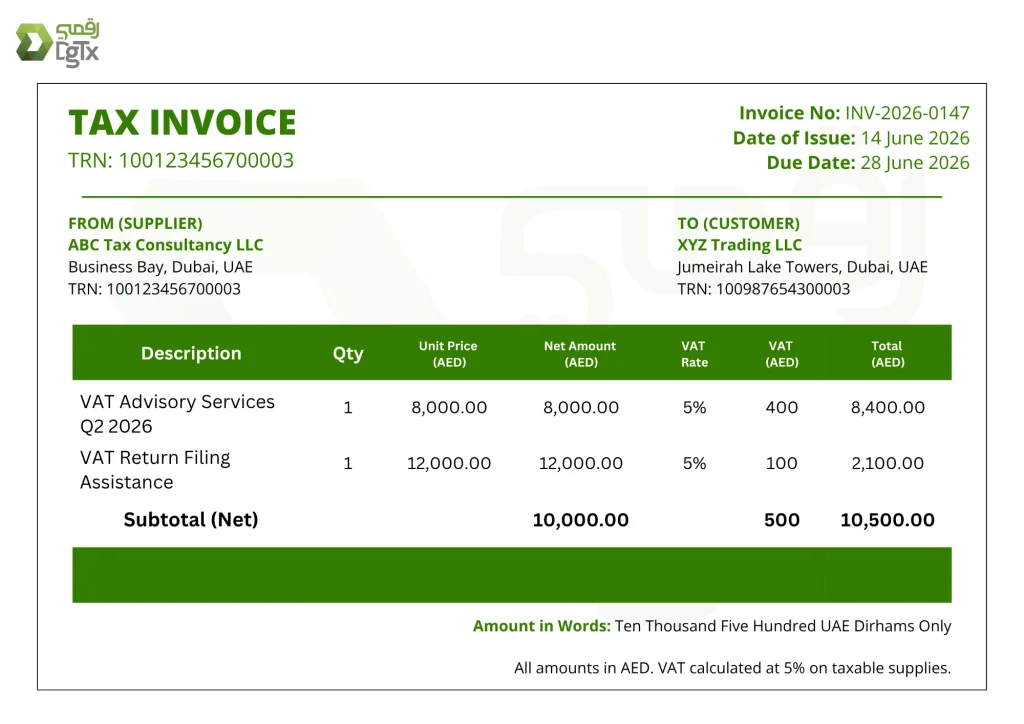
This example demonstrates how a professional services firm would structure a compliant invoice. Note that the VAT amount (AED 500) is clearly separated from the net amount (AED 10,000), and both the supplier and customer TRNs are prominently displayed.
Creating FTA-compliant invoices does not require specialist software, but following a structured process reduces errors and ensures nothing is missed.
Verify your Tax Registration Number (TRN) is valid and active on the FTA portal before issuing any invoice. Your TRN must appear on every tax invoice you issue.
Each invoice must carry a unique, sequential reference number. Never reuse or skip numbers — the FTA expects an unbroken audit trail from your records.
Include your full legal company name, registered UAE address, and TRN prominently. For B2B transactions, collect and include your customer’s TRN before issuing the invoice.
The standard UAE VAT rate is 5%. However, certain supplies — including exports, international transport, and healthcare — may qualify for zero-rating (0%). Always verify the correct rate before invoicing.
The net amount, VAT amount, and gross total must each be displayed as separate line items. Bundling these figures together is a common compliance error.
UAE tax law requires businesses to retain tax invoices and supporting records for a minimum of five years (and fifteen years for records relating to real estate transactions).
A reusable template saves time and ensures compliance consistency across every transaction. Whether you use accounting software, a spreadsheet, or a Word processor, your standard tax invoice template should include the following structural sections:
| Section | What to Include |
|---|---|
| Header | Company logo, “Tax Invoice” title, invoice number, issue date, due date |
| Supplier Block | Business name, address (emirate and area), TRN |
| Customer Block | Customer name, billing address, TRN (if registered) |
| Line Items Table | Description, quantity, unit price (excl. VAT), VAT rate %, VAT amount, line total |
| Totals Section | Net subtotal, total VAT, grand total (incl. VAT) — each on a separate line |
| Payment Terms | Due date, accepted payment methods, bank account details (IBAN) |
| Footer | Currency (AED), any notes on zero-rated or exempt items, signature if required |
Many popular accounting platforms — including Zoho Books, QuickBooks, and Xero — offer UAE VAT-ready invoice templates that are pre-configured to meet FTA requirements.
Even experienced businesses make invoicing errors that can attract FTA scrutiny. The following are the most frequently observed compliance failures in UAE VAT audits:
Penalty Note: Under UAE VAT law, failure to issue a correct tax invoice can attract an administrative penalty of AED 5,000 per incorrect invoice. Repeat violations carry higher fines.

Ensuring every tax invoice meets FTA requirements protects your business from penalties, supports input tax recovery for your clients, and keeps your VAT returns accurate. If you need expert guidance on VAT registration, invoice compliance, or FTA audit preparation in the UAE, our sregistered tax agent are here to help.
Corporate Tax Compliant invoicing is not merely a procedural obligation — it has direct financial and operational implications for your business.
The FTA invoice format is the structure required by the Federal Tax Authority for all tax invoices issued by VAT-registered businesses in the UAE. It must include 16 mandatory fields such as the supplier’s TRN, customer TRN, invoice number, date of issue, line item descriptions, VAT rate, VAT amount, and the grand total including VAT.
Yes. The supplier’s Tax Registration Number (TRN) is mandatory on all tax invoices. Additionally, the customer’s TRN must be included on full tax invoices when the customer is a registered VAT business. Issuing an invoice without a valid TRN is a compliance violation that can result in penalties.
A full tax invoice is required for B2B transactions and supplies valued at AED 10,000 or more. It must include the customer’s name, address, and TRN. A simplified tax invoice is permitted for smaller B2C retail transactions below AED 10,000 and does not require the same level of customer detail. Only a full tax invoice supports input tax recovery.
Under UAE VAT regulations, a tax invoice must be issued within 14 days of the date of supply. Issuing invoices late constitutes a compliance breach and may be flagged during an FTA audit.
Yes. The FTA accepts both paper and electronic (e-invoices) tax invoices, provided all mandatory fields are present and the document is clearly identifiable as a Tax Invoice. Electronic invoices must be stored securely and be retrievable for audit purposes.
UAE tax law requires businesses to retain tax invoices and related records for a minimum of five years from the end of the relevant tax period. For records related to real estate transactions, the retention period is 15 years.
Issuing a non-compliant tax invoice can result in an administrative penalty of AED 5,000 per incorrect invoice. It can also result in your customer being unable to claim input tax recovery, damaging your business relationship. During FTA audits, patterns of non-compliance can escalate to larger penalties.
Yes. FTA regulations require that the net amount (excluding VAT), the VAT amount charged, and the total amount (including VAT) are all displayed as separate, clearly labelled figures on a full tax invoice. Combining these into a single total without breakdown is non-compliant.
Need help? Our team is just a message away