

Reviewed by the Corporate Tax team at DgTx — FTA-registered Tax Agent · ISO 9001 certified · Dubai, Sharjah, Abu Dhabi
Quick Answer The UAE corporate tax filing deadline is nine months after the end of your financial year. For a year ending 31 December 2025, the return and the payment are both due by 30 September 2026. There is no single national deadline. Your date is driven entirely by your own year-end, and the FTA does not grant routine extensions. If you registered late, a separate seven-month deadline applies to your first return — 31 July 2026 for a December year-end — to secure the waiver of the AED 10,000 late registration penalty. |

UAE Corporate Tax was introduced under Federal Decree-Law No. 47 of 2022. It applies at 0% on taxable income up to AED 375,000 and 9% above that threshold. Returns are filed through the Federal Tax Authority’s EmaraTax portal.
The rule itself is short: a Corporate Tax return must be submitted within nine months after the end of the relevant tax period. The complication is that businesses read this as a fixed calendar date, when it is actually a moving one. Because most UAE companies run a January to December financial year, 30 September dominates the conversation — but a company with a March year-end has an entirely different deadline, and treating September as universal is how a compliant business becomes a late one.
One more distinction matters before we go further. Filing and payment share the same deadline. There are no provisional or advance instalments in the UAE regime; the full liability falls due with the return.
The timeline below shows the structure. Most businesses only have one deadline. Businesses that registered late have two, and the earlier one is worth real money.
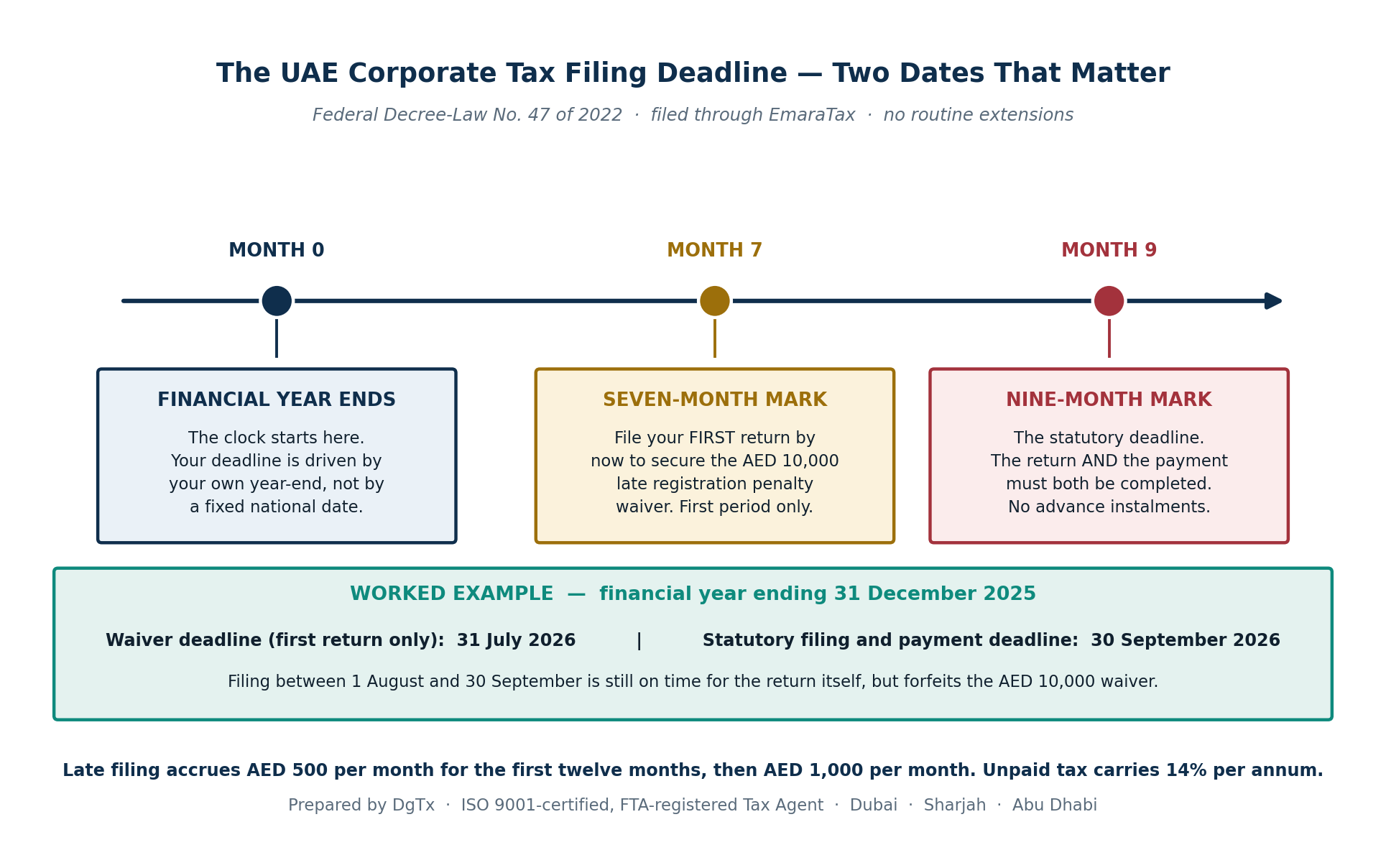
Diagram 1. The nine-month statutory deadline and the seven-month penalty waiver deadline.
Find your year-end in the left column. The deadline in the right column applies to both the return and the payment.
Financial Year End | Corporate Tax Return and Payment Due | Waiver Deadline (First Return Only) |
31 December 2025 | 30 September 2026 | 31 July 2026 |
31 January 2026 | 31 October 2026 | 31 August 2026 |
31 March 2026 | 31 December 2026 | 31 October 2026 |
30 June 2026 | 31 March 2027 | 31 January 2027 |
30 September 2026 | 30 June 2027 | 30 April 2027 |
Any other date | Nine months after the year-end | Seven months after the first period end |
Table 1. Corporate tax filing deadlines by financial year end. Always confirm your own tax period in EmaraTax rather than assuming a calendar year.

The late registration penalty for Corporate Tax is AED 10,000. Thousands of UAE businesses incurred it — often small companies that held a trade licence primarily for visa purposes and did not realise registration was mandatory regardless of profit.
The FTA introduced a waiver initiative to resolve this. Under it, the penalty is cancelled — or refunded if already paid — provided the taxable person files their first Corporate Tax compliance return, or in the case of an exempt person their annual declaration, within seven months from the end of the first tax period rather than the standard nine.
Three features of the initiative are frequently misunderstood, and each one costs money when missed.
The scale tells you how common the underlying problem was. By May 2026 the FTA reported that beneficiaries had exceeded 68,600 taxable persons, and stated it expected the figure to rise to around 91,000, with roughly 22,000 businesses still able to submit registration applications under the initiative.
The trap in the eight-week gap For a December 2025 year-end, filing on 15 August 2026 is perfectly on time for the statutory deadline of 30 September. But if you registered late, that same filing forfeits the AED 10,000 waiver, which closed on 31 July. If there is any chance your registration was late, treat the seven-month date as your real deadline and ignore the nine-month one entirely. |

The filing obligation follows registration, not profitability. A return is required even where the final liability is zero.
Situation | Filing Obligation |
Taxable income below AED 375,000 | File. The 0% band sits inside the same calculation; it is not an exemption from filing. |
The business made a loss | File. Losses must be declared to be carried forward against future profits. |
No revenue during the period | File. A dormant registered entity still files. |
Small Business Relief elected | File a simplified return. The election is made in the return itself. |
Qualifying Free Zone Person at 0% | File. The 0% rate on qualifying income is claimed through the return, not assumed. |
Exempt person required to register | Submit the annual declaration within the applicable window. |
Table 2. Filing obligations by business situation.
Small Business Relief allows a resident business with revenue at or below AED 3 million to treat its taxable income as nil and file a simplified return. It is a transitional measure, currently available for tax periods ending on or before 31 December 2026 unless extended. Businesses relying on it should be planning now for the period after it falls away, because the first full-rate filing tends to expose weaknesses in record-keeping that the simplified return concealed.
Failure | Penalty |
Late filing of the Corporate Tax return | AED 500 per month for the first twelve months, rising to AED 1,000 per month thereafter |
Late payment of Corporate Tax | Interest of 14% per annum on the outstanding balance under the unified regime of Cabinet Decision No. 129 of 2025, effective 14 April 2026 |
Late registration | AED 10,000, subject to the waiver initiative described above |
Failure to keep required records | Administrative penalty applies; records must be retained to support every figure in the return |
Table 3. Indicative penalties relevant to the corporate tax filing deadline. The schedule is periodically revised — confirm the current position on the FTA portal before relying on these figures.
The structure of the late filing penalty rewards fast correction. A return filed two months late costs AED 1,000; the same return left for eighteen months costs AED 12,000 in monthly accruals alone, before any interest on unpaid tax. There is no scenario in which delaying improves the outcome.
Businesses that miss the corporate tax filing deadline rarely fail at the portal. They fail at the accounting. The EmaraTax submission takes hours when the books are reconciled; it takes weeks when they are not, because every figure in the return must reconcile to financial statements you can produce on request.
A practical rule from filing season: start the computation at month six, not month eight. The gap between those two starting points is the difference between a considered filing position and a rushed one.
DgTx is an ISO 9001-certified financial consultancy and an FTA-registered Tax Agent, operating in strategic partnership with Etisalat from offices in Dubai, Sharjah and Abu Dhabi. The firm has supported more than 5,000 clients across the Emirates and submitted over 15,000 cases to the Federal Tax Authority.
Our Corporate Tax support covers:
If your first Corporate Tax period has ended and you have not yet filed, the most valuable thing you can do this week is confirm two dates: your statutory deadline,VAT Compliance and whether a seven-month waiver window is still open to you.