
Reviewed by the Indirect Tax team at DgTx — FTA-registered Tax Agent · ISO 9001 certified · Dubai, Sharjah, Abu Dhabi
|
Quick Answer Yes. VAT on bank charges in UAE applies at the standard rate of 5% whenever a bank charges an explicit fee for a service — account maintenance, transfers, cheque books, card fees, ATM usage or trade finance commissions. However, banking income that the bank earns from a margin rather than a stated fee — such as loan interest, deposit interest and foreign-exchange spread — is an exempt or out-of-scope financial service and carries no VAT. A VAT-registered business can usually recover the 5% it pays on bank charges as input tax, provided the account supports taxable supplies and the business holds acceptable documentation. |
Value Added Tax was introduced in the United Arab Emirates on 1 January 2018 under Federal Decree-Law No. 8 of 2017. It is a consumption tax collected at each stage of the supply chain, with the final cost borne by the end consumer. The standard rate is 5%, and it remains 5% in 2026 — none of the recent legislative amendments changed the rate itself.
Banking is not a single VAT category. Under UAE VAT law, banking sits inside the wider basket of “financial services”, and financial services deliberately receive split treatment. Some banking activity is standard-rated at 5%, some is exempt, and some is outside the scope of VAT entirely. This is why two lines on the same bank statement can carry completely different tax consequences.
For a UAE business, the practical question is rarely academic. Every current account generates a stream of small charges — maintenance fees, transfer commissions, cheque returns, card fees — and each one may contain recoverable input VAT. Ignored across a year, this becomes a quiet and avoidable leak of cash.
Yes. Bank charges in the UAE are subject to 5% VAT wherever the bank makes an explicit charge for a service. UAE banks publish this position openly. Emirates NBD states in its schedule of charges that fees and commissions are inclusive of VAT or a similar sales tax. Standard Chartered UAE states that its listed fees are inclusive of 5% VAT where applicable. First Abu Dhabi Bank confirms that, in line with the UAE VAT implementation from 1 January 2018, 5% VAT is levied on the fees and charges specified in its commercial banking schedule wherever UAE law applies it.
The nuance that catches businesses out is presentation. Some banks quote fees VAT-inclusive, so the AED 26.25 you see on the statement is already AED 25.00 plus AED 1.25 of VAT. Others quote VAT-exclusive and add the 5% as a separate line. Both approaches are legitimate, but they require different arithmetic when you post the entry, and getting this wrong is one of the most common bookkeeping errors we see during a VAT health check.
The single most useful concept in this entire subject is the distinction between fee-based and margin-based financial services. It explains almost every classification decision you will ever need to make about a UAE bank statement.
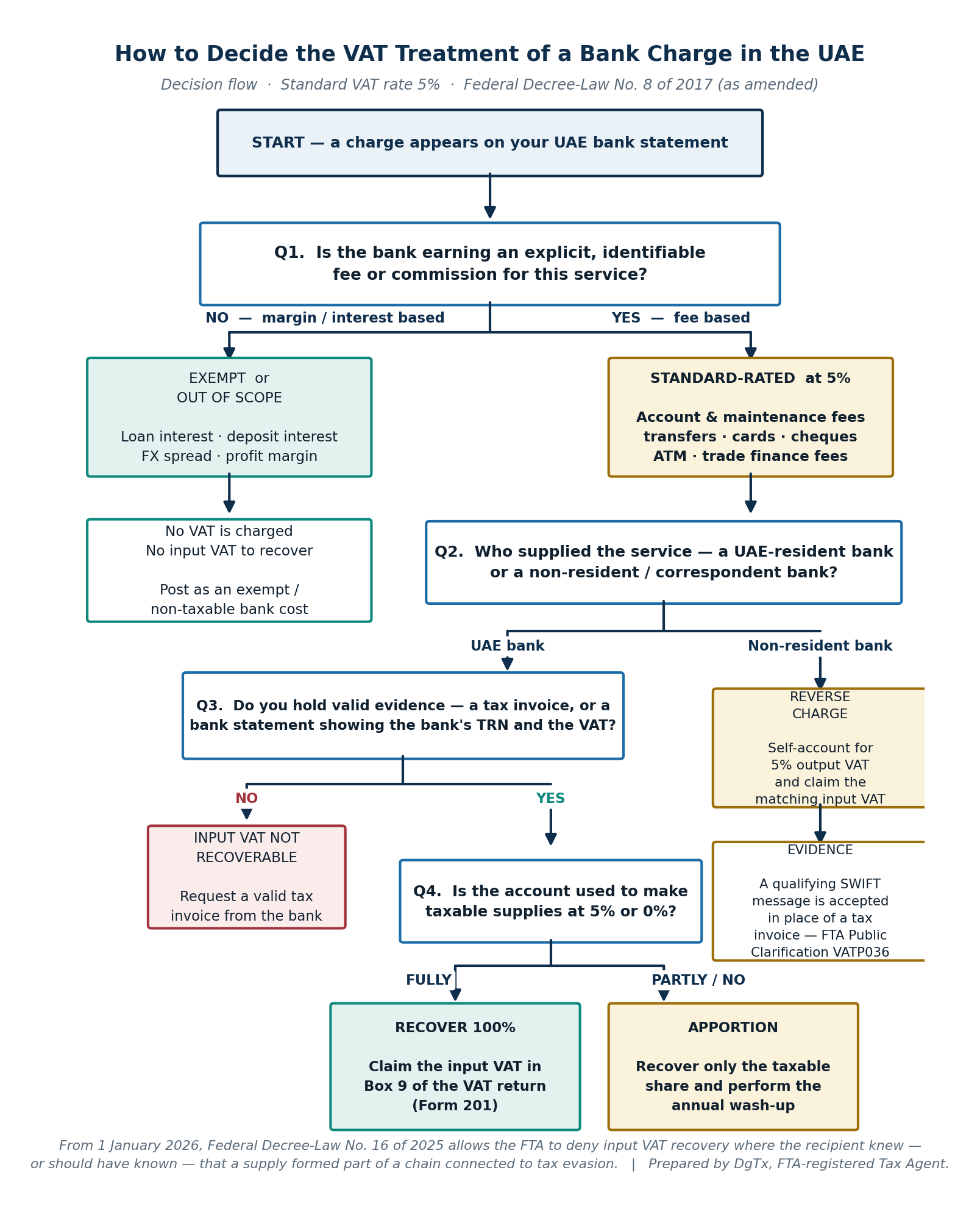
Diagram 1. Decision flow for determining the VAT treatment of any charge appearing on a UAE bank statement.
When a bank charges a stated amount for a stated action, the consideration is explicit and measurable. There is a clear price attached to a clear service, which is exactly the condition VAT is designed to tax. Examples include an account maintenance fee, a telegraphic transfer commission, a cheque book issuance fee, a credit card annual membership fee, a cash-handling charge or an advisory fee. All of these are standard-rated at 5%.
When a bank earns its income from the spread between two prices rather than from a stated fee, there is no identifiable consideration to tax. The classic examples are interest on a loan, interest paid on a deposit, and the difference between the buy and sell rate on a currency exchange. These are treated as exempt financial services. Because they are exempt rather than zero-rated, the bank cannot recover input tax attributable to them — which is one reason banks price fee-based services the way they do.
A helpful test: ask whether you could point to a line in the bank’s published tariff that names a price for the thing you received. If you can, it is almost certainly standard-rated. If the bank’s reward is buried in a rate rather than a price, it is almost certainly exempt.
The table below groups the charges that typically carry 5% VAT. Fee amounts differ by bank, account tier and relationship pricing, so always check your own bank’s published schedule of charges; the VAT treatment, however, is consistent across institutions.
|
Category |
Typical Charges Included |
VAT Treatment |
|
Account administration |
Account opening and closing fees, monthly or quarterly maintenance fees, minimum-balance fall-below fees, dormant account fees, bank statement or certificate issuance |
Standard-rated 5% |
|
Payments and transfers |
Local transfer commission, telegraphic and international wire transfer fees, SWIFT charges, standing instruction fees, payment amendment or tracer fees, stop-payment instructions |
Standard-rated 5% |
|
Cheque services |
Cheque book issuance, cheque return charges, manager’s cheque and demand draft issuance, cheque clearing fees |
Standard-rated 5% |
|
Cards |
Credit and debit card annual or membership fees, card replacement fees, cash advance handling fees, late payment administration fees, supplementary card fees |
Standard-rated 5% |
|
ATM and cash handling |
Out-of-network ATM withdrawal fees, cash deposit or withdrawal handling charges, coin and change handling, bulk cash processing |
Standard-rated 5% |
|
Trade finance and guarantees |
Letter of credit issuance and amendment commission, bank guarantee commission, documentary collection handling fees |
Standard-rated 5% |
|
Advisory and safekeeping |
Investment advisory fees, wealth or portfolio management fees, brokerage commission, safe deposit locker rental, custody and administration fees |
Standard-rated 5% |
|
Priority and subscription |
Priority banking package subscriptions, relationship management packages, premium service tiers |
Standard-rated 5% |
Table 1. Bank charges that are standard-rated at 5% VAT in the UAE. Categories are indicative; confirm the specific line against your bank’s tariff.
The exempt side of the ledger is narrower but financially larger, because it covers the interest flows that dominate most bank relationships.
|
Banking Item |
VAT Treatment |
Why |
|
Interest paid to you on a current, savings or fixed deposit account |
Exempt / outside scope |
Passive return on a deposit; not consideration for a supply you make |
|
Interest and profit charged on loans, overdrafts and finance facilities |
Exempt |
Margin-based consideration with no explicit fee |
|
Foreign-exchange gain earned by the bank through the buy/sell spread |
Exempt |
Consideration is implicit in the rate, not stated as a fee |
|
Issue, transfer or redemption of shares, bonds and other securities |
Exempt |
Dealings in money and securities are excluded from the tax base |
|
Dividend income received by the account holder |
Outside scope |
Return on ownership, not consideration for a supply |
|
Life insurance and life reinsurance sold through the bank |
Exempt |
Specific exemption for life assurance products |
|
Loan arrangement or processing fee charged as a stated amount |
Standard-rated 5% |
Important exception: the fee is explicit even though the interest is not |
Table 2. Exempt and out-of-scope banking transactions, with the one exception businesses most often miss.
|
Watch this exception A single loan can produce both treatments at once. The interest is exempt, but a stated “processing fee” or “arrangement fee” on the same facility is standard-rated at 5%. Split the entry — do not classify the whole facility by its headline product. |
Because UAE banks commonly quote fees on a VAT-inclusive basis, the arithmetic runs backwards from the figure debited to your account. The formula to extract the tax from a VAT-inclusive amount is: VAT = gross amount × 5 ÷ 105. Equivalently, the net cost is the gross amount ÷ 1.05.
|
Scenario |
Amount Debited (AED) |
Net Cost (AED) |
VAT (AED) |
Recoverable Input VAT |
|
Monthly account maintenance fee (VAT-inclusive quote) |
105.00 |
100.00 |
5.00 |
5.00 |
|
International telegraphic transfer commission |
78.75 |
75.00 |
3.75 |
3.75 |
|
Cheque book issuance |
26.25 |
25.00 |
1.25 |
1.25 |
|
Credit card annual fee |
735.00 |
700.00 |
35.00 |
35.00 |
|
Cheque return charge |
105.00 |
100.00 |
5.00 |
5.00 |
|
Bank guarantee commission (quarterly) |
2,625.00 |
2,500.00 |
125.00 |
125.00 |
|
Loan interest debited |
4,000.00 |
4,000.00 |
Nil — exempt |
Nil |
|
Monthly totals |
7,675.00 |
7,500.00 |
175.00 |
175.00 |
Table 3. Worked example for a single month, assuming a fully taxable business and VAT-inclusive bank pricing. Figures are illustrative.
Extrapolate that monthly figure of AED 175 across twelve months and the business is looking at AED 2,100 of recoverable input tax from bank charges alone. For a group running several accounts across multiple entities, the annual figure routinely reaches five figures. It is real money, and it is lost permanently if it is never posted to the correct ledger account.
Recovery is not automatic. UAE VAT law sets conditions, and the FTA applies them strictly during audit. Three tests must be satisfied before input tax on a bank charge can be claimed.
Input tax is recoverable only to the extent the underlying cost supports the making of taxable supplies, meaning supplies at 5% or 0%. If the bank account exists purely to receive exempt income — for example a holding company account that only collects dividends, or an entity whose sole income is interest — the input VAT on its bank charges is not recoverable. Where an account supports a mixture of taxable and exempt activity, apportionment applies.
The FTA expects a valid tax invoice as the default evidence for any input tax claim. A compliant tax invoice must display the words “Tax Invoice”, the supplier’s name, address and Tax Registration Number, the recipient’s details where the recipient is registered, a unique sequential number, the date of supply and issue, a description of the service, the amount excluding VAT, the tax rate and the tax amount in AED.
The recipient must have paid, or intend to pay, the consideration within six months of the agreed payment date. For bank charges this is rarely an issue, as the fee is debited directly from the account at the moment it is incurred — but the condition still forms part of the statutory test and should be understood by the finance team applying it.
|
Business Situation |
Input VAT on Bank Charges |
Action Required |
|
VAT-registered business making only taxable supplies at 5% or 0% |
Fully recoverable |
Claim 100% in Box 9 of the VAT return |
|
VAT-registered business with a mix of taxable and exempt income |
Partially recoverable |
Apply input tax apportionment and complete the annual adjustment |
|
Entity whose income is entirely exempt (e.g. pure interest or dividend income) |
Not recoverable |
Post the VAT to expense; it is an absolute cost |
|
Business below the registration threshold and not registered |
Not recoverable |
VAT is a cost; monitor turnover against the AED 375,000 threshold |
|
Personal or director’s account used for private purposes |
Not recoverable |
Exclude from the business VAT return entirely |
|
Charges on an account used for both business and personal transactions |
Partially recoverable at best |
Separate the accounts; mixed-use accounts are an audit red flag |
Table 4. Input VAT recovery position on bank charges by business profile.
This is the most frequently asked practical question about VAT on bank charges in UAE, and the answer requires care.
A bank statement is not automatically a tax invoice. In practice, however, most UAE banks design their statements and their periodic VAT summaries so that the required particulars are present — the bank’s Tax Registration Number typically appears in the statement footer, and many banks issue a separate monthly or quarterly VAT statement listing each chargeable fee with the tax broken out.
The safe position is straightforward. Where the statement shows the bank’s TRN and separately identifies the VAT amount, it can generally support recovery. Where the statement shows only a single lump-sum debit with no VAT breakdown and no TRN, request the bank’s VAT statement or a tax invoice before claiming. Most UAE banks provide these on request through corporate online banking, and several generate them automatically each period.
|
Documentation checklist for bank charge input tax 1. The bank’s Tax Registration Number is visible on the document. 2. The VAT amount is separately identifiable, or the document states that fees are VAT-inclusive at 5%. 3. The charge is dated within the tax period being filed. 4. The account is a business account in the registered entity’s legal name. 5. The record is retained for at least five years, in line with UAE record-keeping requirements. |
International payments introduce a second layer. When funds move abroad, the sending bank is rarely the only institution taking a cut. Correspondent and intermediary banks deduct their own charges en route, and those deductions frequently appear on your statement as a separate debit or as a shortfall in the amount received by the beneficiary.
Where the service is supplied by a non-resident bank to a UAE-resident business, the reverse charge mechanism applies. The UAE recipient self-accounts for the 5% output VAT and, in the same return, claims the corresponding input VAT where entitled. For a fully taxable business the effect is cash-neutral — but it is not reporting-neutral, and omitting the entry misstates the return even when no tax is ultimately payable.
In February 2024 the Federal Tax Authority issued Public Clarification VATP036, addressing the documentation problem created by interbank services. UAE financial institutions receiving services from non-resident banks are treated as making self-supplies and would, in principle, need to issue tax invoices to themselves for each transaction. Given the sheer volume of SWIFT traffic, the FTA accepted that this was impractical.
The clarification permits a simplification: where a SWIFT message contains sufficient information to establish the particulars of the supply — a qualifying SWIFT message — the UAE financial institution is not required to self-issue a tax invoice, and the SWIFT message itself is accepted as documentary evidence supporting input tax recovery. Although VATP036 is directed at the financial services sector, its logic on acceptable evidence is worth understanding for any UAE business handling significant cross-border banking flows.
Businesses that generate both taxable and exempt income cannot recover all of their input tax. Bank charges are usually a general overhead — the account serves the whole business — so the VAT on them falls into the residual pool that must be apportioned.
The standard method is turnover-based: the recoverable proportion equals taxable supplies divided by total supplies for the period. A provisional recovery rate is applied during the year, and an annual wash-up adjustment reconciles the position once the full-year figures are known.
|
Line |
Amount (AED) |
Notes |
|
Taxable supplies for the year |
8,000,000 |
Standard-rated and zero-rated combined |
|
Exempt supplies for the year |
2,000,000 |
Interest income and exempt lease income |
|
Total supplies |
10,000,000 |
Denominator for the recovery ratio |
|
Recovery ratio |
80% |
8,000,000 ÷ 10,000,000 |
|
Total input VAT on bank charges for the year |
4,200 |
Residual overhead pool |
|
Recoverable input VAT |
3,360 |
4,200 × 80% |
|
Irrecoverable input VAT (absolute cost) |
840 |
Post to profit and loss as an expense |
Table 5. Illustrative turnover-based apportionment of input VAT on bank charges.
Amendments to the UAE VAT Law took effect on 1 January 2026 under Federal Decree-Law No. 16 of 2025. The standard rate stayed at 5% and the financial services exemptions were left intact, but the administration of recovery tightened in ways that matter for every recurring cost, including bank charges.
|
Change |
What It Means in Practice |
|
FTA may deny input tax where evasion is present in the chain |
Recovery can be refused where the recipient knew — or should have known — that a supply formed part of a chain connected to tax evasion. Holding a valid invoice is no longer, by itself, a complete defence; documented supplier verification is now expected. |
|
Self-invoicing under the reverse charge removed |
Businesses no longer need to issue a tax invoice to themselves for imported goods and services under the reverse charge. Supplier invoices and import records must still be retained, so the evidence burden shifts rather than disappears. |
|
Five-year cap on carrying forward excess recoverable VAT |
Excess input VAT may be carried forward for a maximum of five years from the end of the tax period in which it arose. If it is neither used against liabilities nor claimed as a refund in that window, the entitlement lapses permanently. |
|
Transitional relief window |
Businesses whose five-year period had already expired, or expires within one year of 1 January 2026, were given until 31 December 2026 to submit outstanding refund claims. |
|
Limitation periods moved to the Tax Procedures Law |
Audit and assessment time limits are now governed solely by the Tax Procedures Law rather than by a dedicated article in the VAT Decree-Law. |
Table 6. Key VAT amendments effective 1 January 2026 and their impact on input tax recovery.
For bank charges specifically, the practical consequence of the first item is modest but real: your bank is a regulated, FTA-registered institution, so supply-chain risk is low. The wider lesson is procedural. If your finance function is being asked to evidence verification for suppliers generally, the same discipline should extend to how bank charge VAT is captured, evidenced and reconciled each period.
Correct classification is only half the job; the figures also have to land in the right box on the return submitted through EmaraTax.
|
Form 201 Box |
What Goes There |
Bank Charge Relevance |
|
Box 3 — Supplies subject to the reverse charge |
Output VAT self-accounted on services received from non-residents |
Charges from non-resident or correspondent banks |
|
Box 5 — Exempt supplies |
Value of your own exempt supplies |
Interest income you earn, where it constitutes an exempt supply |
|
Box 9 — Standard-rated expenses |
Input VAT on domestic purchases and expenses |
Primary box for 5% VAT paid on UAE bank charges |
|
Box 10 — Supplies subject to the reverse charge |
Input VAT side of the reverse charge entry |
The recoverable half of the non-resident bank charge entry |
Table 7. Where bank charge VAT belongs on the UAE VAT return.
The penalty framework changed in 2026, so it is worth knowing the current shape of it.
|
Violation |
Penalty Position |
|
Late VAT return filing |
AED 1,000 for a first offence; AED 2,000 if repeated within 24 months, applied per return |
|
Incorrect tax return |
AED 500 under Cabinet Decision No. 129 of 2025, with relief where the error is corrected before the deadline or via voluntary disclosure producing no additional tax |
|
Late payment of VAT |
From 14 April 2026, interest of 14% per annum on the unpaid balance, replacing the former 2% immediate plus 4% monthly structure capped at 300% |
|
Late VAT registration |
AED 10,000, plus backdated liability from the date registration was required |
|
Failure to keep required records |
Fixed administrative penalty under the current schedule; records must be retained for at least five years |
Table 8. Indicative FTA administrative penalties. The schedule is periodically updated — verify the current position on the FTA portal or with your tax agent before relying on these figures.
DgTx is an ISO 9001-certified financial consultancy and an FTA-registered Tax Agent, operating in strategic partnership with Etisalat and serving clients from offices in Dubai, Sharjah and Abu Dhabi. The firm has supported more than 5,000 clients across the Emirates and submitted over 15,000 cases to the Federal Tax Authority.
Bank charge VAT is a small line in isolation and a systemic issue at scale. It sits at the intersection of bookkeeping accuracy, VAT classification and audit readiness — which is precisely where DgTx works. Our support covers:
If you are unsure whether your business has been recovering VAT on bank charges correctly, a review of the last four filed returns will usually answer the question quickly — and often identifies recoverable amounts that are still within the claim window.
Is VAT applicable on bank charges in the UAE?
Yes. Bank charges in the UAE are subject to 5% VAT wherever the bank makes an explicit charge for a service, including account maintenance, transfer commissions, cheque book issuance, card fees and ATM charges.
What is the VAT rate on bank charges in the UAE in 2026?
The rate is 5%. The standard VAT rate in the UAE has remained at 5% since implementation on 1 January 2018, and the amendments effective 1 January 2026 did not change it.
Is VAT charged on bank interest in the UAE?
No. Interest received on deposits and interest charged on loans is margin-based rather than fee-based, and is treated as an exempt or out-of-scope financial service. No VAT applies and no input tax arises.
Can I claim input VAT on bank charges in the UAE?
Yes, if you are VAT-registered, the account supports the making of taxable supplies, and you hold acceptable documentation showing the bank’s TRN and the VAT amount. Businesses with exempt income must apportion rather than recover in full.
Is a bank statement enough to claim input VAT on bank charges?
Often, but not always. Where the statement displays the bank’s Tax Registration Number and separately identifies the VAT, it can generally support a claim. Where it shows only a lump-sum debit with no VAT breakdown, request the bank’s VAT statement or a tax invoice before claiming.
Are UAE bank fees quoted inclusive or exclusive of VAT?
It varies by bank. Several major UAE banks publish schedules stating that fees and charges are inclusive of VAT, while others state that 5% will be levied in addition. Check your bank’s schedule of charges, because the two conventions require different calculations.
How do I calculate the VAT contained in a VAT-inclusive bank fee?
Multiply the gross amount by 5 and divide by 105. A fee of AED 105 contains AED 5 of VAT and AED 100 of net cost.
Is VAT charged on international bank transfer fees in the UAE?
Yes. The transfer commission charged by your UAE bank is standard-rated at 5%. Charges deducted by non-resident correspondent banks are handled separately under the reverse charge mechanism.
Does VAT apply to credit card annual fees in the UAE?
Yes. Credit and debit card annual or membership fees, replacement fees and cash advance handling fees are explicit fees for a service and are standard-rated at 5%. Interest charged on an outstanding card balance is exempt.
Do free zone companies pay VAT on bank charges?
Yes. VAT and Corporate Tax operate independently, and free zone status does not exempt a company from VAT on banking services. Free zone entities registered for VAT recover input tax on bank charges under the same conditions as mainland businesses.
Where do bank charges go on the UAE VAT return?
Input VAT on charges from a UAE bank is reported in Box 9 (standard-rated expenses) of Form 201. Charges from non-resident banks are reported under the reverse charge in Box 3 on the output side and Box 10 on the input side.
What happens if I have been claiming VAT on bank charges incorrectly?
Errors should be corrected, either in the next return where permitted or through a voluntary disclosure. Voluntary correction is consistently less costly than discovery during an FTA audit, and a tax agent can advise on the right route for the size and nature of the error.
|
About the Author This article was prepared and reviewed by the Indirect Tax team at DgTx, an ISO 9001-certified financial consultancy and FTA-registered Tax Agent operating in Dubai, Sharjah and Abu Dhabi in strategic partnership with Etisalat. The team comprises tax consultants, chartered accountants and financial advisors who handle VAT registration, return filing, audit and Corporate Tax compliance for businesses across the Emirates. Last reviewed: August 2026. Reviewed against Federal Decree-Law No. 8 of 2017 as amended by Federal Decree-Law No. 16 of 2025, and FTA Public Clarification VATP036. Disclaimer: This content is general guidance and does not constitute tax, legal or accounting advice. VAT treatment depends on the specific facts of each business. Speak to a qualified tax agent before acting. |